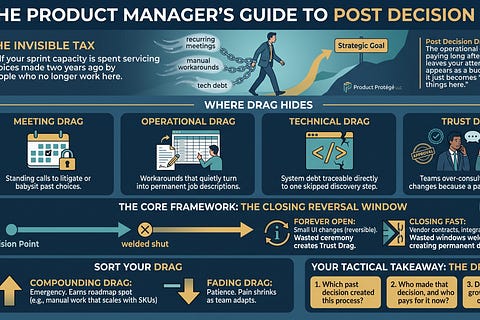
How I Turned a 3-Year Wishlist into a 6-Month Roadmap
The Art of Prioritization: A Balancing Act for Product Leaders
By Jason Abdo
When I started as my company’s first-ever product manager (will not name names!) , one of my first task was to build a six-month roadmap.
I was immediately met with a flood of requests, demands, and confusion—from
“Are you the project manager?”
to stakeholders who felt the next release was already “owned” by their business unit.
I quickly realized that everyone had their own six-month plan.
When I combined them, I was looking at a three-year wishlist. For a company that had never planned beyond an initial website build, this was a recipe for failure.
My immediate temptation was to start negotiating with each stakeholder 1-on-1, trying to trade one feature for another.
But that would have been a tactical, zero-sum game.
The real problem wasn’t the list of features; it was the lack of a shared understanding of what we were trying to accomplish.
Instead of negotiating, I partnered (I probably mention this about 10x a day while coaching my clients.
This was my first step into the Envision phase of product leadership.
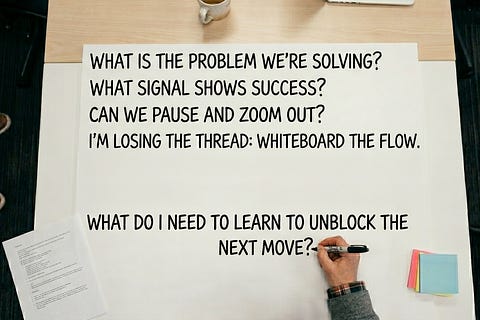
I met with each business head and asked three simple questions:
What are your top two strategic pillars for the year?
If we are successful, what signals or metrics will we see?
Our focus is “personalization”—what does that word actually mean to you and your team?
The answers were thoughtful but wildly different.
One leader’s “personalization” was another’s “segmentation.”
Success metrics ranged from revenue to engagement to operational efficiency.
I put each business lead’s answers on a single slide that summarized their answers and brought all the business leaders together.
The “aha” moment was powerful. By seeing their different perspectives, they understood the root of the problem. There was massive misalignment. I don’t feel like the intention was to have different definitions, but since I was the first product manager on the team, I was the first person to ask.
From there, we worked together to bring together their ideas into a single, unified strategy with clear, shared KPIs that all rolled up to one King KPI.
We had created a shared environment for decision-making.
^This is so important
When you have an understood and shared environment, saying “no” was dramatically easier.
We had an agreed-upon strategy to point to. Better yet, the new ideas coming in were already aligned with our global strategy and goals, not just siloed business unit needs.
But creating that shared environment wasn’t the end of the story.
I learned that prioritization is about leading a constant conversation with moments in time where we agree on what’s next.
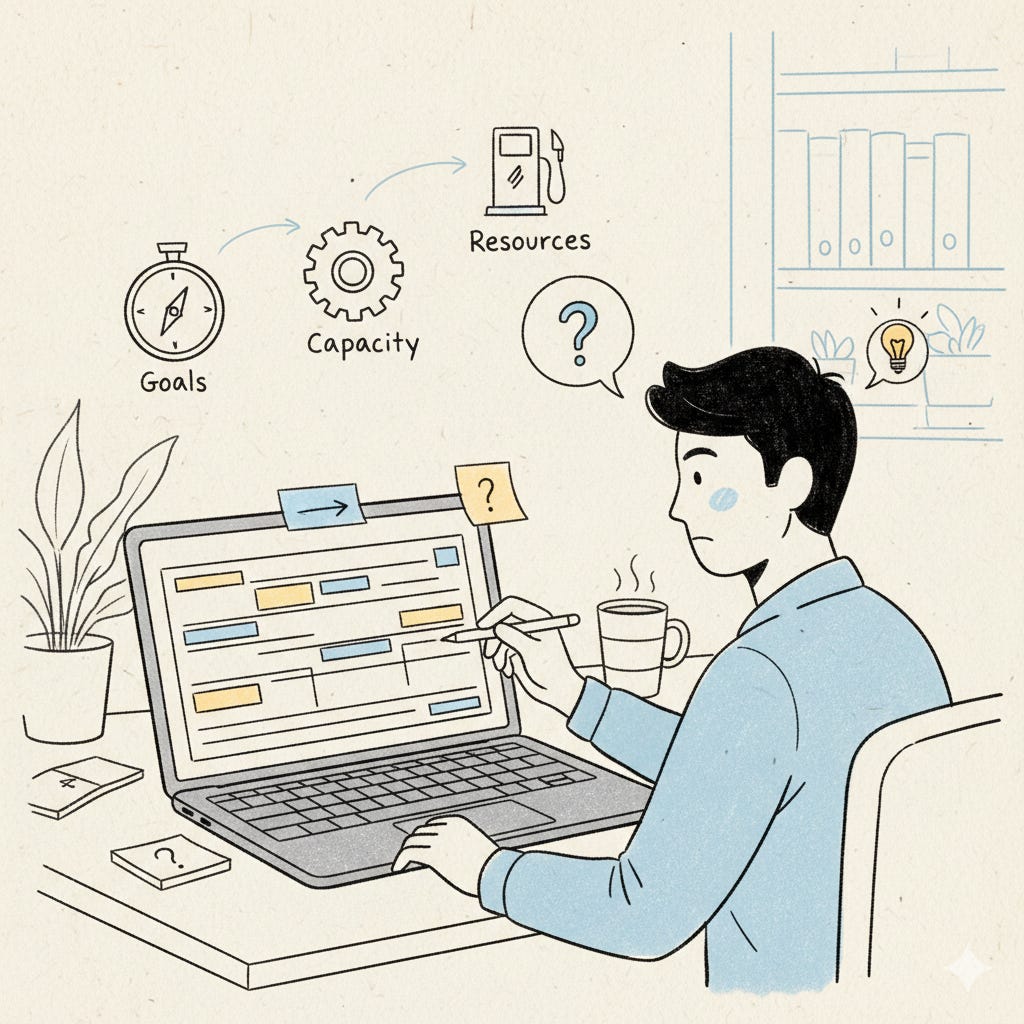
That initial strategic alignment gave us our Map. But to get anywhere, you have to balance the Map with your Engine and your Fuel. (I hope this analogy helps!)
The Art of the Balancing Act
Successful product work comes from balancing three levers.
1. The Map (Your Big Goals) 🗺️
This is your vision and strategy. It answers, “Where are we going?” and “Why?” The strategy we built from those stakeholder conversations became our map, giving the entire team a clear destination.
2. The Engine (Your Team’s Power) ⚙️
This is your team’s real-world capacity to execute (Devs, UX, QA, Analytics). It’s the power and speed of the team you have right now. My three-year wishlist had to be reconciled with the reality of what our small team could actually build. This is the Empower phase—giving your team a realistic plan they can bring to life (Scope, Quality, and Speed - you only get to pick 2!) .
3. The Fuel (Your Resources) ⛽
This is your budget and headcount. To take on bigger projects or accelerate your timeline, you need to justify getting more fuel. You do this by proving your current work is delivering measurable value—the Elevate phase.
The Traps of Imbalance
John Cutler was recently discussing the traps of imbalance in his latest substack “Stop trying to make prioritization easy.”
My initial three-year wishlist which was just stacking all the requests in sequence was a classic “Fantasy Land” trap—all Map, no respect for the Engine.
When these levers are out of sync, you are not only going to disappoint, but you also have risks that pop up like execution ability, coherence risk, and quality issues.
The “Fantasy Land” Trap (Ambition > Capacity): You have ambitious goals but ignore your team’s capacity. This leads to burnout and broken promises.
The “Busy Work” Trap (Capacity > Ambition): Your team is highly productive but lacks a clear strategic map. They ship a lot of features, but none of them move the needle on what truly matters. It’s like biking really efficiently but not going the right direction.
The “Wasted Resources” Trap (Investment without Elevating wins): You get more budget for new ideas before proving the value of existing ones. This leads to wasted effort and a lack of focus.
Dealing with any of these? Scroll down for some protege tips on how to handle!
Your Real Job: Facilitate the Dialogue
Your role as a product leader is to facilitate the continuous conversation between the Map, the Engine, and the Fuel. The tools you use every day help structure this dialogue.
A Pitch Deck helps you have a data-driven debate about The Map. It forces everyone to ask, “Is this destination truly worth the journey?”
A Roadmap communicates the route you’re taking with The Engine you have available.
KPIs and Value Updates function as your Fuel Gauge, providing the evidence you need to justify more resources for the journey ahead.
Don’t look for a perfect framework to solve prioritization. Instead, focus on leading this balancing act. Use data to connect your team’s daily work to the big picture, and you will build a more aligned, effective, and successful product organization.
Now, let’s get tactical..
Here is a more detailed breakdown of each failure mode.
1. The “Fantasy Roadmap” Trap (Ambition > Capacity)
This is the most common trap. It occurs when Strategic Ambition is completely disconnected from the reality of Execution Capacity.
What It Looks Like: The roadmap is packed with major initiatives, all marked as “P1” or “due this quarter.” The team is constantly context-switching, trying to make progress on ten things at once. Features remain “90% done” for months. Deadlines are constantly pushed, and team morale plummets because they feel like they can never win. Leadership sees a lot of activity but very few results.
The Root Cause: A failure to say “no.” The product leader is acting as an order-taker for stakeholders rather than a strategic partner. There’s no objective process for evaluating trade-offs, so every “good idea” gets added to the list. The pain of making a strategic choice now is avoided in favor of the bigger pain of team burnout and delivery failure later.
The Protégé Fix: You must ground ambition in reality. This is where frameworks become your best defense against wishful thinking.
Mandate the Pitch Deck: No initiative gets on the roadmap without a data-backed Pitch Deck. This forces stakeholders to prove an idea is a
problem worth solving and it’s actually a problem before it ever consumes team capacity.
Use RICE Scoring: This framework explicitly forces a conversation about Effort. When a stakeholder sees their high-effort, low-reach idea scored objectively against a low-effort, high-reach one, the trade-off becomes clear and data-driven, not emotional.
2. The “Efficiently Building the Wrong Thing” Trap (Capacity > Ambition)
This trap occurs when the team’s Execution Capacity is strong, but there is no clear Strategic Ambition guiding it.
What It Looks Like: The team is a well-oiled machine. They complete their sprints, their velocity is high, and they consistently ship features. The problem? No one is sure if any of it matters. Key business metrics remain flat. User feedback is lukewarm. The team is celebrated for being “busy” and “productive,” but they are working in a strategic vacuum. This is the definition of a “feature factory.”
The Root Cause: A failure in the Envision phase. The product lacks a clear, customer-centric vision and measurable strategic pillars. Without a North Star, the team defaults to building what’s easy, what’s technically interesting, or what the last person who cornered the PdM in the hallway or on slack asked for. (Why is it always at 5pm too?!)
The Protégé Fix: You must start at the top of the Product Empowerment Pyramid.
Define the Vision & Strategy: Use a structured framework like our 777 Guide to articulate a clear vision and 3-4 strategic pillars.
Connect Every Initiative to a KPI: Every item on the roadmap must be explicitly tied to a strategic pillar and a KPI it is expected to influence. This ensures your team’s powerful engine is always pointed toward a meaningful destination.
But Jason, my stakeholders are not going to go through this process for each little task. Nor should they! My rule of thumb is if the initiative takes less than 2 sprints, there should be a way to fast track production support, tech debt, and important bugs.
3. The “Wasting Money on Unproven Bets” Trap (Investment without Elevating wins)
This trap happens when New Investment is made based on ambition alone, without the discipline of learning from past results. The Elevate phase is missing.
What It Looks Like: Headcount and budgets grow, but business results don’t scale with them. The organization has a habit of chasing “shiny objects” and launching big, splashy new projects before ever confirming if the last big project actually delivered value. Success is measured by the launch date, not the long-term outcome.
The Root Cause: A lack of accountability and a broken feedback loop. The team is not closing the loop by measuring the impact of their work and communicating it. Without data proving what works and what doesn’t, decisions about future investment are based on opinions, politics, and gut feelings—a notoriously poor way to allocate capital.
The Protégé Fix: You must install a disciplined Elevate loop.
Deliver Value Updates: After every launch, the PdM is responsible for measuring the impact and delivering a Value Update to stakeholders. Did the feature move the KPI we targeted in the Pitch Deck? Why or why not?
Earn the Next Investment: The insights from these updates become the foundation for your next decision. You either optimize what you’ve built or you make a data-backed case for a new investment. You earn the right to ask for more resources by proving you are an effective steward of the ones you already have.
Until next week!
Jason
First published in Protege Pulse, the Product Protégé newsletter. Read it on Substack.