Play Where You Have the Advantage
Why your edge matters more than your effort in product management
By Jason Abdo
Shane Parrish calls it your “circle of competence.”
The idea is simple: You’re more likely to win when you operate where you already have an edge.
The hard part?
Figuring out where that edge is.
It takes time.
It takes honesty.
And it takes feedback—especially the kind that challenges your assumptions.
At Product Protégé, we can advise and teach you what to do.
But we prefer to help you build the mindset and judgment to figure it out on your own.
That’s the only way you’ll get better at product over time.
This is why we developed our E3 Framework and accompanying guides and templates. ← Even for free!
Don’t ask for answers. Ask for variables.
If you ask an expert what to do, they’ll give you their answer.
You might apply it —but you won’t understand why it works.
If you ask what variables matter and why, you gain insight into their thinking.
You can apply it in different situations, and make better calls in the future.
That’s what we teach.
Learn how to think through the why and the what.
How to think through vision, strategy, prioritization, research, and execution.
How to know when you’re out of your depth and when to ask for help.
How to go a mile deep on what matters—and not get distracted by noise.
The mindset that matters most
Shane Parrish highlights three key practices to develop your circle of competence:
Curiosity
A desire to learn—and the humility to admit when you don’t know. Not a bad idea to ask an expert “tell me more.”Monitoring
Keep a record of what’s working, where you’re improving, and where you’re not.Feedback
Get real input from others, especially when it’s uncomfortable.
Shane says:
“If you start to feel defensive when someone gives feedback, focus instead on the outcome you’re trying to achieve.”At Product Protégé, we say:
”Set ego aside. Align around impact. Stop negotiating. Start partnering.”
Protégé Tip: Listen to the right people, at the right time
You don’t need to know everything.
But you do need to know who to go to—and when.
Let’s say you're finalizing next quarter's roadmap.
You’re confident Feature X is a priority.
But then:
Engineering flags major technical debt.
UX says the flow doesn’t match user expectations.
Analytics reveals there’s no current way to track its impact.
At that moment, you have two choices:
Push ahead based on your assumptions and disregard your co-creators input.
Or pause and learn from the input.
This is where your circle of competence shows up.
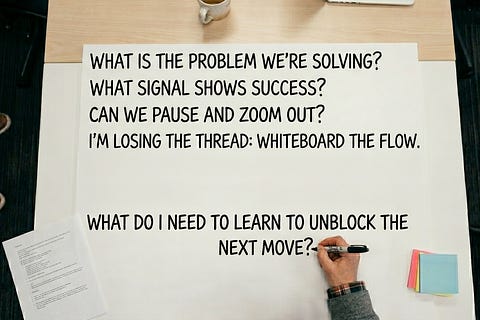
Not in having all the answers—but in knowing the right questions to ask:
What trade-offs are we making if we do this now?
Where are we constrained—tech, time, people?
How will we know if this actually worked?
What real problem does this solve for our users—and how do we know?
Does this idea align with our product vision—or is it just a distraction?
Did I ask my co-creators for their input on how we can create a version of the outcome I hope to achieve?
Are we optimizing for what’s valuable—or just what’s easy to ship?
Who needs to weigh in to make this decision real—not just approved?
Protégé Tip: A solid roadmap doesn’t come from having the loudest opinion.
It comes from listening early, asking clearly, and adjusting based on what’s real.
That’s the difference between building what’s on your mind—and building what your team can actually ship, measure, and improve.
Protégé Tip: Go deep where it counts
You don’t need to be good at everything.
You need to go deep where it matters most:
Understanding your users
Clarifying your vision
Shaping your product’s strategy
Making smart trade-offs
Driving toward real outcomes
Understanding how to transparently prioritize a roadmap
Able to tell your product’s narrative to various audience types
We help PMs develop that edge with our True Product Skill Assessment and Archetype Test.
It places you in one of four zones:
Executor, Dreamer, Operator, or Innovator.
This shows how you work—and what to work on next.
Excited to share more on this shortly!
Learning is just experience plus reflection
Growth doesn’t come from shipping alone.
It comes from thinking about what you shipped, why it worked, and how you’d do it differently next time.
You can learn from your peers.
You can learn from experts.
You can learn from that one TEAMs convo that made you pause and reconsider.
The key is to stay open—and stay curious.
Some people A/B test product recommendation slots (which I help with).
I make sure to also A/B test smoked meats and side dishes.
Same idea. Different domain.
Try something. Learn something. Repeat.

Protégé Tip: Don’t mistake feedback for judgment
You can’t grow if you filter out anything that feels uncomfortable.
You need people who will give it to you straight—without trying to protect your feelings.
Ask them:
What do I not see about myself?
Where do I tend to miss things?
What would you trust me to own, and what wouldn’t you?
You don’t have to agree with everything.
But you do need to consider it.
If your team is ready to level up—not with a set of rigid answers, but with frameworks that adapt to reality—we’re here for that.
Let’s build product people who know how to think.
—
Every so often, we drop one insight to help you grow as a product thinker, strategist, and decision-maker.
Not fluff. More tactics than theory. Just what works.
Until next time,
Product Protégé
First published in Protege Pulse, the Product Protégé newsletter. Read it on Substack.