Your Roadmap Is Not the Territory
A Lesson in Product Leadership, Communication, and Adaptability
By Jason Abdo
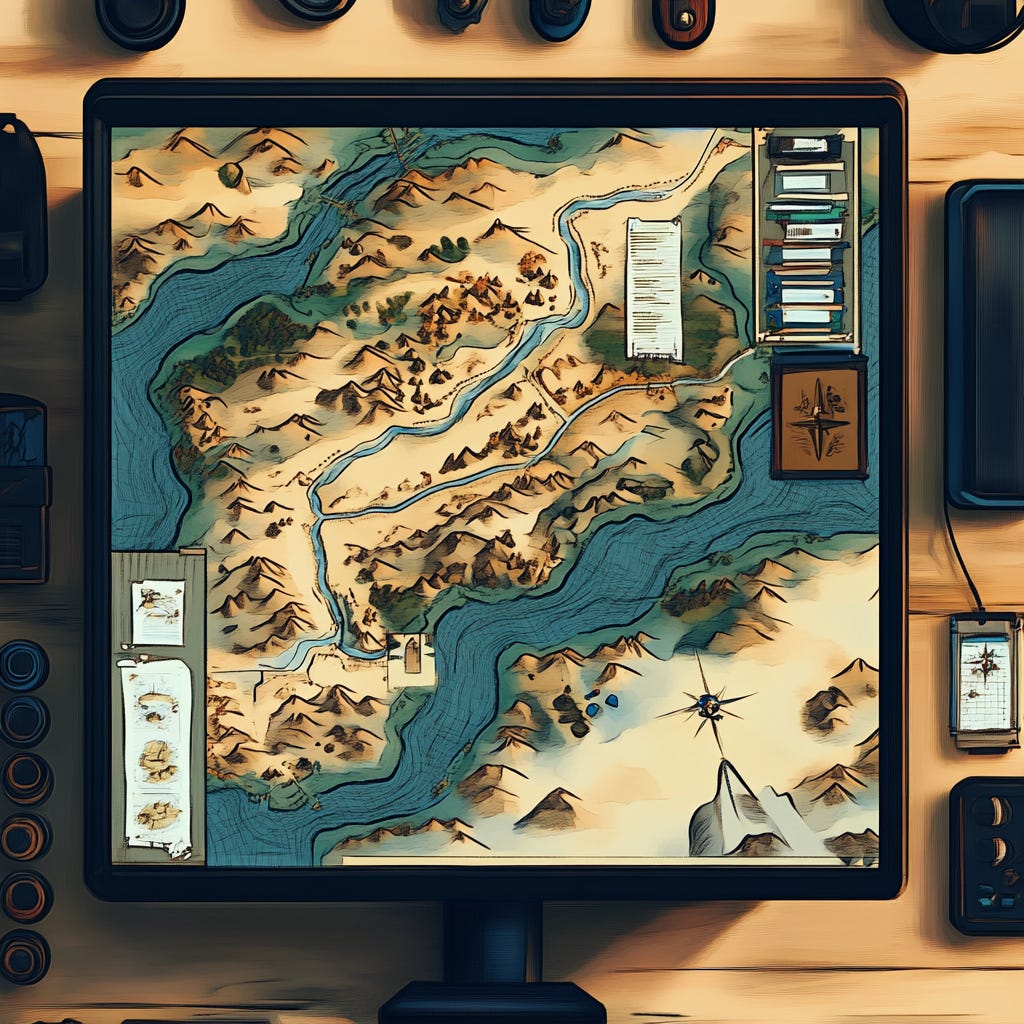
There’s an old saying in cartography: “The map is not the territory.”This phrase, originally from Alfred Korzybski and echoed in Shane Parrish’s The Great Mental Models, is one of the most powerful mental models for product managers.
Because here’s the truth—our artifacts (roadmaps, strategies, frameworks, OKRs) are not reality. They are opinionated representations of reality, snapshots in time that help us navigate complexity.
But here’s where many product managers get stuck…
…they start treating the map as the truth rather than an interpretation of the truth.
When that happens, we lose the ability to adapt when the terrain inevitably shifts.
Market Changes
Customer Expectations Shift
So how do we avoid this trap? Let’s break it down.
1. The Territory Changes, So Your Map Must Change Too
Every product manager has been there:
You spend weeks perfecting your roadmap. You refine the prioritization framework, align stakeholders, and build compelling pitch decks. It’s a work of art.
Then—three months later—everything changes.
A new regulation impacts your business model.
A competitor launches a feature faster than expected, and it’s 18 months out on your roadmap.
User behavior shifts in ways your data couldn’t have predicted.
Suddenly, your roadmap is outdated.
This is normal, right. Yes - this is expected and should be set as an expectation with your co-creators.
The key isn’t to avoid change—it’s to design for it.
🔹 What Success Looks Like:
Your roadmap is a living document, not a contract. Did everyone hear that?
You communicate shifts in the context of the larger narrative (“This isn’t a deviation—it’s a necessary pivot given the qualitative and quantitative feedback from the market and our customers.”)
You set expectations upfront that certainty beyond a few sprints is 50/50 in product management.
💡 Protégé Tip: Regularly ask yourself, What assumptions did we make when we created this roadmap? Which of those assumptions are still true today?

2. Don't Trust Every Map—Ask Better Questions
Product managers rely on frameworks, best practices, and case studies—but these are other people’s maps.
They were created based on different territories, different market conditions, and different customer needs.
If you apply them blindly, you’ll end up lost.
If you use their map as a lens to your terrain…this is a better strategy.
This is what I coach the E3 Framework for students who take our course.
🔹 What Success Looks Like:
You ask territory-focused questions rather than map-focused ones.
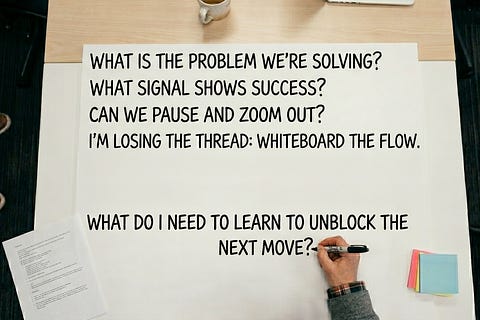
Instead of asking, What framework should I use?, ask What is the nature of the problem I’m solving?
You contextualize every borrowed strategy:
Is this framework useful for my team, customers, business model, and current market conditions?
💡 Protégé Tip: Next time someone says, This is how we did it at [big tech company]—pause. Ask, What made that approach successful for them? Do those same conditions exist for us?
3. Present the Territory, Not Just the Map
Imagine this
Context: You’re a PdM at a fictitious digital bank working on payment systems.
What’s happening? You’ve been invited to present your roadmap at the Quarterly Business Review (QBR).
You walk in feeling prepared.
Your roadmap is solid.
It reflects months of prioritization efforts, trade-offs, and customer research.
But within minutes, the meeting goes sideways.
The Chief Product Officer interrupts: “Why are we prioritizing instant payouts over fraud detection?”
The CFO frowns: “I don’t see the business case here. Where’s the revenue impact?”
Your engineering lead chimes in: “Some of these initiatives aren’t technically feasible within this timeline.”
What happened?
You presented the map (your roadmap) without explaining the territory.
Your audience doesn’t just need to see the “where” (features and timelines)—they need to understand the why.
What’s the problem?
Why is it a problem?
What observations have you made to find the white space in this market that will provide value for our customers/business?
More importantly, they need to hear it at the right level of depth based on who they are.
Let’s talk communication…
The Three Levels of Communication: Adapting Your Narrative
Shreyas Doshi on Lenny’s podcast talked about this…
1️⃣ Execution-Level (Co-creators: Developers, Designers, Analysts, QA)
What they care about: The how. Sprint-level details, technical feasibility, blockers.
How you communicate: Granular details, user stories, system diagrams.
Example: “Instant payouts require changes to our ledger system, and we’re testing edge cases on settlement delays.”
2️⃣ Impact-Level (Stakeholders: Boss, Business Leaders, Other PMs)
What they care about: The why. Trade-offs, risks, and alignment with business goals.
How you communicate: Outcome-focused, with a blend of qualitative insights and quantitative data.
Example: “We prioritized instant payouts because 60% of failed transactions are due to settlement delays, costing us $3M annually in lost retention.”
3️⃣ Optics-Level (VPs, C-Suite, Customers)
What they care about: The story. How does this tie into the company vision? What’s the broader narrative?
How you communicate: Clear, plain-language storytelling without technical jargon.
Example: “We’re making payments instant, so our customers can access their money exactly when they need it—no delays, no frustration.”
What Success Looks Like:
You tailor your message based on who is in the room.
You proactively frame “the why” in terms of approaches, trade-offs and risks rather than waiting for others to point them out.
You shift from defending the roadmap to explaining the territory.
💡 Protégé Tip: Before any major presentation, ask yourself: Am I presenting the map, or am I explaining the terrain?
Final Thought: Your Role as the Cartographer
A good product manager isn’t just a navigator—they’re a cartographer.
Your job is to create maps that help your team explore new opportunities, avoid pitfalls, and reach the right destination.
But maps have limits. They’re approximations. Your real skill lies in reading the landscape, sensing shifts in the market, and adapting accordingly.
So keep your maps flexible. Keep your questions sharp. And most importantly—keep your eyes on the actual terrain.
Because the map is not the territory. And great product managers know the difference.
Until Next Time…
Keep curious & stay interesting.
💡 Want to go deeper? Check out more insights in the Product Protégé Guide at www.productprotege.com
🔗 Recommended Reading:
The Great Mental Models by Shane Parrish (because product management is about how you think and tell a narrative).
Product Protégé Guide: The Art of Product Management (because the Envision, Empower, & Elevate Framework is flexible and helps you craft the communication of a dynamic roadmap)
First published in Protege Pulse, the Product Protégé newsletter. Read it on Substack.