The E3 Product Mindset: how an idea becomes a live product
Three phases take an idea from a customer problem to a measured result. Envision, Empower, Elevate.
By the Product Protégé Team
The E3 Product Mindset is the repeatable process your product team uses to take an idea from a customer problem to a live, measured product. It has three phases. In Envision, you prove the problem is worth solving. In Empower, you give your co-creators what they need to build it right. In Elevate, you measure what shipped and use what you learned to make the next decision.
Picture this. A VP asks for a feature on Monday. By Friday it sits on your roadmap. Six months later it ships, and nobody can say if it worked.
You have seen this. So have we, on almost every team we meet. Each step in that story has a fix, and E3 puts the fixes in order.
Why your team needs one process
Every Product Manager on your team brings ideas to life a little differently, so your co-creators in engineering, design and analytics relearn the rules on every single project. Quality depends on who wrote the ticket. Your leadership reviews turn into guesswork, because no two pitches answer the same questions.
One shared process changes that. Your co-creators know what they will get and when. Your leaders know which questions every idea has answered before it reaches them. Your new Product Managers have a path to follow in week one. And you can coach the work, because you can point to the step where it went wrong.
Phase 1: Envision
Envision answers one question. Is this problem worth solving?
This is where your Product Manager earns the team's time. The phase has six steps.
- Connect with customers
- Discovery
- Pitch deck with ROI
- Stakeholder perspectives
- Prioritize roadmap
- Formal kickoff
One rule holds the phase together. No idea reaches your roadmap without a one page pitch. The pitch states the problem, the hypothesis, the expected outcomes and the measurement plan, and it fits on one page so a busy leader reads the whole thing. It forces the hard questions early, when answers are cheap. It also gives your leaders something they can fund or decline on the evidence.
Plenty of ideas stop in Envision. Good. Stopping an idea here costs you an hour of someone's time.
Envision ends with a pitch your leadership team can fund or decline on the evidence.
Phase 2: Empower
Empower turns a funded pitch into work engineering builds right the first time. It has six steps.
- Epic
- User stories
- Architect review and refinement
- Stand-ups
- Design, code, QA, analytics
- Review and UAT
The Epic is your source of truth. It holds the pitch, the assumptions, the risks, the open questions and the scope. Anyone who joins the work reads the Epic and knows why the work exists.
User stories break the Epic into requirements your team can test. Write them in Given-When-Then form, and your QA team turns the acceptance criteria straight into test cases.
Product Managers own the why and the what. Co-creators own the how. The clearer you make the why and the what, the more freedom your team has with the how. We call this empowerment through clarity.
Empower ends with work engineering builds right the first time.
Phase 3: Elevate
Launch is the starting line. In Elevate you find out if the bet paid off. Six steps again.
- Go / No-Go
- Stakeholder updates
- Customer engagement and feedback
- Value updates
- Optimization
- Roadmap updates
Your main tool here is the KPI Tree. It connects one feature's measurements to the business KPIs your leadership tracks. Your read out then shows lift in numbers your finance team trusts.
Then you put what you learned back into the roadmap, so the lessons from last quarter shape the bets you place next quarter and the quarter after that.
Elevate ends with a read out that proves the result and sets up your next bet.
How E3 fits with the Product Empowerment Pyramid
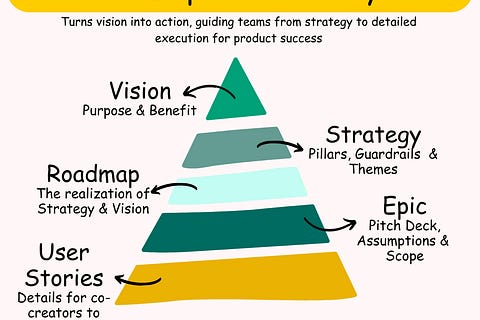
You need both frameworks, and each has its own job. The Product Empowerment Pyramid names the five artifacts your team maintains, from Vision down to User Story. The E3 Product Mindset is the process that moves an idea through those artifacts. You will find both on our Product Approach page.
Where teams get stuck
Three patterns show up again and again.
Teams skip the pitch. An idea lands on the roadmap because someone senior asked for it. Six months later, nobody remembers which outcome it was meant to produce.
Teams treat the ticket as the source of truth. The context lives in a comment thread, and every new team member starts from zero.
Teams stop at launch. They move to the next thing, and your organization never learns which bets paid off.
Sound familiar? The Product Thinking Diagnostic shows you where your team loses the thread, person by person and theme by theme.