Do we understand what it means to be quick and not reckless when delivering product?
The Blueprint for Fast Product Decisions
By Jason Abdo
Quick decisions. Quicker validation. Quickest adjustments through iterative cycles.
You hear the demand to move fast constantly.
But do we understand what it means to be quick and not reckless?
Quick without sacrificing accuracy?
Quick that still maintains high-quality outputs and outcomes?
I spent 16 years in product trenches dealing with this exact pressure. Moving fast requires a solid operating model.
Skipping steps leads to less accurate execution because you are sacrificing accuracy for speed. This can lead to not only bad decisions, but the bad kind of failure, where we fail because we didn’t understand what were all the elements needed for the next decision or how to get them (or that you even needed them!).
In my coaching sessions with product owners to sr. product managers, it becomes clear and super tactical when the lightbulb moment happens - a high-functioning system generates speed.
We spend time examining the necessary preparations (aka product decision readiness?)
This is why we get excited to teach our E3 Operating Model because it does such a good job building the foundation for more rapid execution.
The Relationship Between Speed and Accuracy
Leadership demands fast discovery. They focus entirely on the output. Executing quickly requires immense effort. Moving forward without clear data from your previous step forces you to guess.
You need two specific elements to move fast.
A firm starting point based on validated data.
Clear output variables.
You must know exactly what the next person or task in your workflow requires. Making decisions without these elements guarantees failure or your friendly LLM agreeing that we can vibe forward.
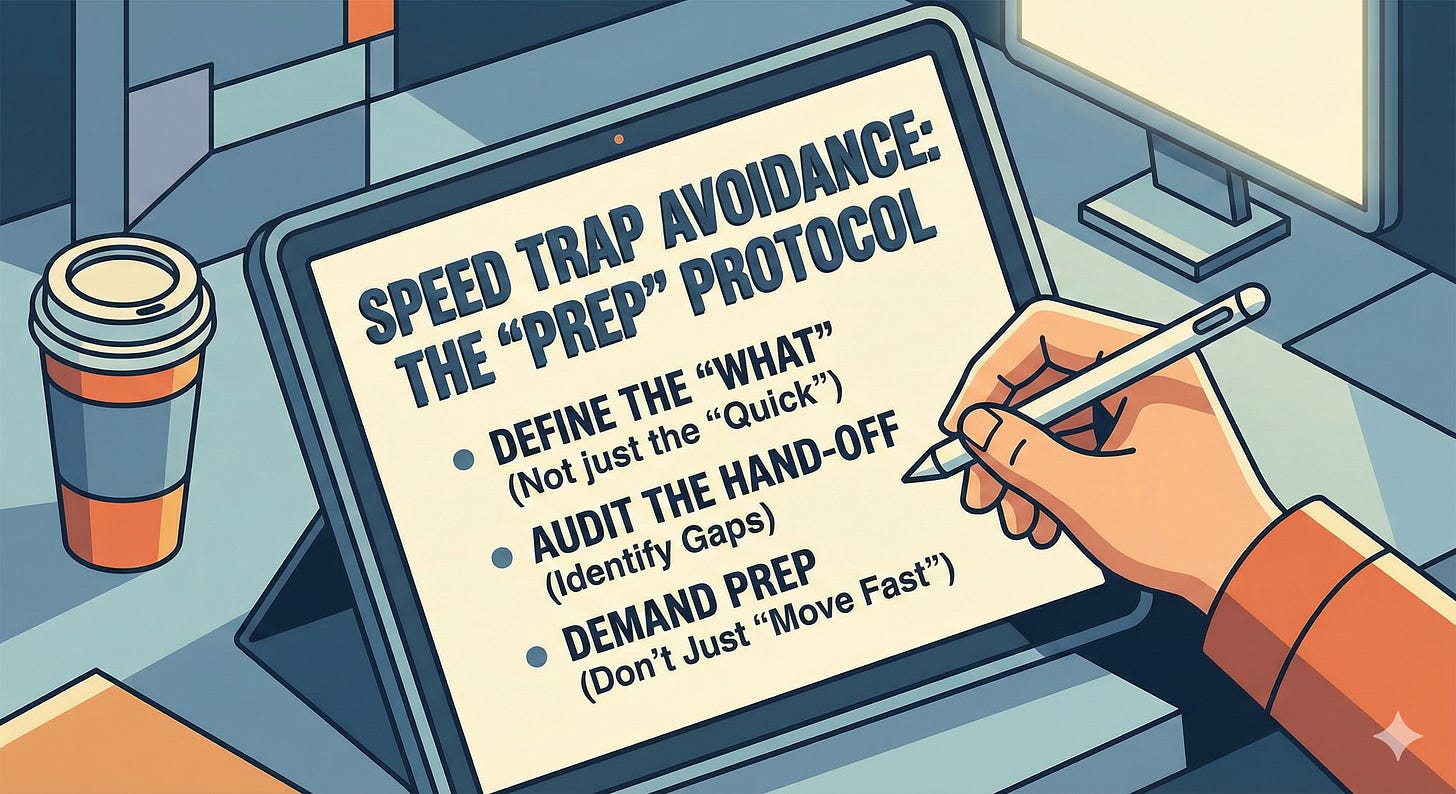
How the E3 Operating Model Enables Speed
The E3 model requires front-loading your effort. Proper preparation accelerates the execution phase.
Cadenced and quality execution standards reduces the mental calories you spend executing (freeing you up to do the proper preparation!)
1. Build Customer Pipelines Early
Fast discovery requires existing infrastructure. Spending two weeks finding five customers kills your momentum.
The E3 Fix: Front-load your customer access pipelines. Build a panel of users who are ready to talk. Make feedback loops easy to access for customers on your digital experience (with repeatable ways to get tactical with your feedback).
This preparation allows you to stay close to customers both reactively (feedback loops on the experience) and proactively (jobs to be done interviews, ethnographic research, etc).
2. Require Clear Output Variables
Teams make mistakes when they act on bad information. This happens when the previous step fails to produce the necessary variables.
The E3 Fix: Require clear criteria for every stage of your model. Finalize the opportunity deck with customer desirability (what problems are we solving?), viability (how does this support the business?) and feasibility (not just technical, but legal, compliance, regulatory, etc) before moving from discovery to delivery.
Protege Tip: The Variable Check
Ask yourself one specific question before finalizing a decision. What is the first question the co-creator that gets this output (designer, developer, qa, etc) will ask me about this? Find the answer to that question before handing off the work and consider your process just slightly more frictionless while building a personal brand of readiness with your co-creators.
A Note to Leadership
Teams struggle when they lack clear variables. Pressuring teams to move quickly without an operating model forces them to use bad data. Demand accurate inputs from your teams. High-quality inputs remove indecision.
Clear information (and alignment on that information) automatically accelerates execution.
For example, if its clear to both the product manager and leader the vision, strategy (trade offs and filters for all ideas) the KPIs that are in our roadmap goals; this environment allows much more aligned autonomy you can provide your product team.
If you are not sure how to do this…
Execute These Three Steps on Monday
You can implement these changes immediately.
Pinpoint the exact information gap in your last delayed project.
Open your issue tracker.
Find the specific ticket that stalled.
Locate the exact moment a developer asked for clarification.
Identify the missing document, acceptance criteria, or dependency.
Jot down in an “all day” calendar invite what you are going to do differently on the day you plan to work on the next similar artifact.
Answer your lead developer’s questions before they ask them.
You know the developer who always finds the edge cases.
Write down the three questions they always ask during refinement (ask them to take a look, edit, or add to!).
They usually ask about error states or whether a feature applies to mobile or web (or something similar).
Jot down in an “all day” calendar invite what you are going to do differently on the day you plan to work on the next similar artifact.
Have someone you supervise or manage? Delegate the user stories for one small feature.
Stop writing every single ticket.
Choose one minor feature this week.
Write only the opportunity statement and your strict constraints.
Give this to your product owner, associate PdM, tech lead or business analyst.
Become the master reviewer/editor for their written user stories, read their draft to verify it solves the customer problem. Coach them if they miss the user value.
The Bottom Line
The E3 Model gives you the tools to execute properly. Proper preparation guarantees accurate decisions. Our Product Protege Guide goes into E3 Operating model and more! Pick up a copy today, most people park it on their desk for quick reference!
First published in Protege Pulse, the Product Protégé newsletter. Read it on Substack.